Web3: Mass adoption in 2026?
The Web3 of 2026 leaves crypto hype behind and establishes itself as a reliable infrastructure for use cases such as the tokenisation of real-world assets on a regulated scale, sovereign digital identity usable in businesses and institutions, and deep integration with AI, zero-knowledge and modular architectures that make complex ecosystems viable in production.
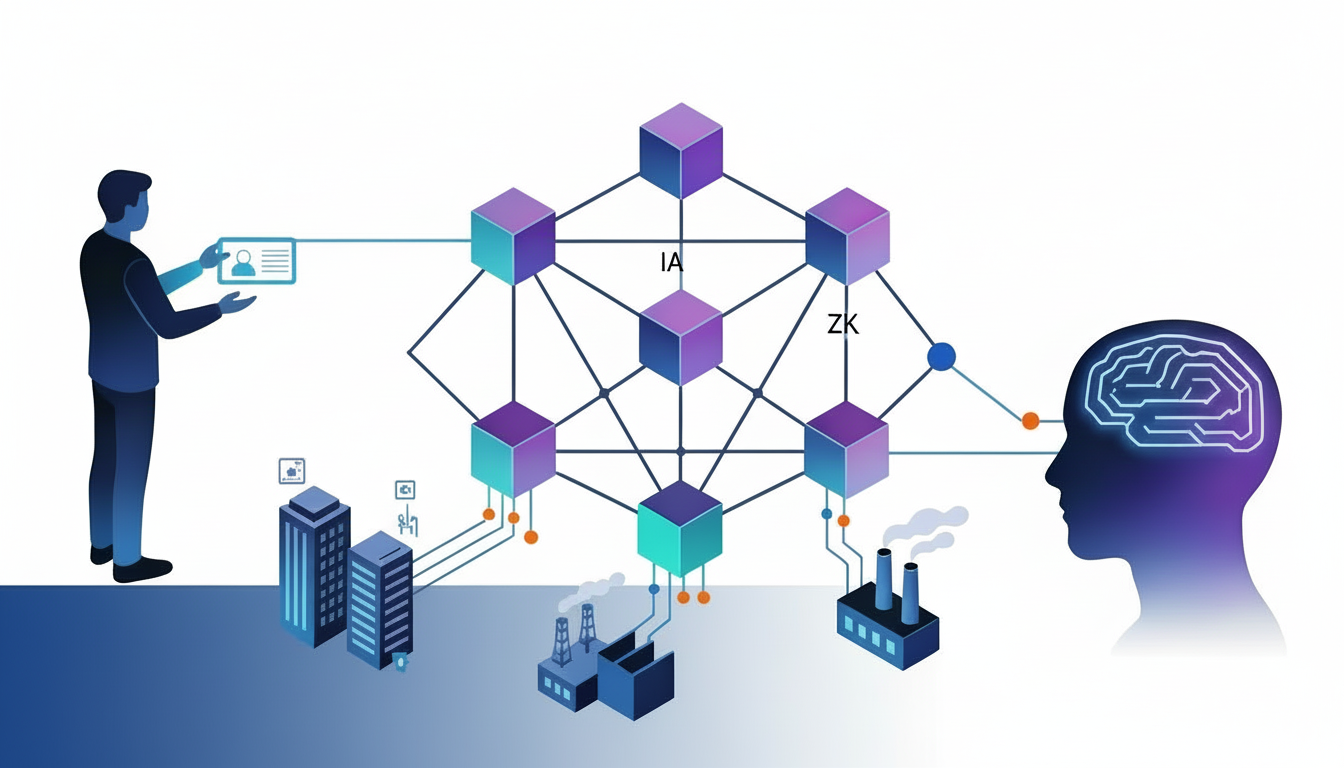
In 2026, web3 will establish itself as a reliable infrastructure not only for financial services or as the basis for the crypto ecosystem, but also for numerous companies and sectors that are beginning to use decentralised networks to automate settlements, verify data and orchestrate flows between organisations that previously relied on ad hoc integrations. The launch of ISBE, Spain’s Blockchain Services Infrastructure, marks both a milestone and a trend, as it is the first sovereign decentralised ecosystem for building stable, auditable and regulation-compliant systems where SLA, ERP integration and regulatory compliance in blockchain-based networks are discussed openly. Below we outline some trends in the web3 universe that we expect to be talked about in 2026.
Tokenisation of real-world assets
The tokenisation of real-world assets (RWA) is becoming established and will continue to gain traction in 2026. Real estate, invoices, gold, art and even intellectual property are being tokenised, allowing for negotiable fractions that reduce the minimum entry ticket to markets and facilitate liquidity management. This trend is particularly novel in the business world, where inventory and invoices are being tokenised, allowing for more flexible working capital financing, the use of tokens as collateral in liquidity systems, and the automation of collections and payments via smart contracts. Regulated institutions and fintech start-ups are beginning to offer tokenised investment products packaged for end users, integrating KYC/AML and with regulated custody of assets on both public and hybrid networks.
Decentralised identity and data verification
Self-sovereign identity (SSI) is moving from a theoretical concept to an implementable stack with wallets that store verifiable credentials for banks, employers, and applications. Certificates, documents, and proof of identity can be shared selectively, minimising data leaks of the ‘upload your PDF and trust’ variety. This pattern simplifies the onboarding required for regulatory compliance in financial services and opens up new possibilities for making electronic signatures and digital public services more accessible. In sectors such as healthcare and education, verifiable credentials ensure that medical records, degrees, or professional licences have not been altered and actually come from the issuing entity. For the user, the key change is that control of the data is refocused on their wallet, and verifiers consult evidence rather than copying entire databases. Highly relevant cases related to reliable user authentication and cyber fraud prevention are also beginning to emerge.
ZK, privacy and modular architectures
2026 brings significant advances in zero-knowledge cryptographic proofs, better known by their acronym, ZKP. This technology allows private transactions to be recorded on networks, identities to be verified, and off-chain business logic to be executed with on-chain publication of proofs, maintaining verifiable transparency without exposing all data. Until now, it has been very costly and complex to deploy this type of technology in production services. New approachs and solutions make it possible to consider implementing business flows that require contractual confidentiality but want to ensure that rules are automatically enforced. At the same time, modular designs for decentralised ecosystems — where consensus, execution and storage are decoupled — and layer 2 solutions are beginning to provide alternative solutions to ensure both scalability and fee containment. New modular architectures that decouple functions allow optimal components to be chosen for each use case, reduce the cost of deploying high-performance applications, and enable the secure and confidential processing of sensitive data.
Interoperability and cross-chain as the norm
Interoperability becomes a basic requirement, not a nice-to-have, with new layers of cross-chain messaging that allow assets and information to be moved between different networks. Developers can design unified experiences where the user interacts with a single interface while the backend orchestrates actions across multiple chains. This approach reduces the fragmentation of digital asset liquidity and the duplication of business logic. On the other hand, it also requires strengthening security in bridges and messaging protocols, identified as one of the most critical points of failure in the ecosystem.
Web3 + AI Integration
One of the most powerful areas of growth for 2026 is the integration between web3 and AI with two approaches. On the one hand, blockchain acts as a layer of verification and governance for data and models, helping to build them while ensuring their traceability and explainability. If models are increasingly making decisions based on data, it is better for the data to be accredited and to be able to verify the decisions made by the model and the results thereof. In this way, developers explore patterns in which the chain certifies the origin of training datasets, records model versions, and ensures that the outputs associated with a user respect their property rights. On the other hand, decentralised computing networks allow AI tasks to be executed without relying on a single cloud provider, opening up markets for distributed GPU/TPU providers orchestrated and remunerated on-chain. This fits in with the narrative of ‘data and models as assets’ whose ownership and access are governed by smart contracts and specialised DAOs.
UX and security: the challenges ahead
Despite advances, user experience remains one of the main obstacles: managing wallets, seed phrases and gas remains complex for the average user. Projects are working on account abstraction and delegated custody with cryptographic guarantees to close this gap. We are beginning to hear the concepts of ‘walletless’ and ‘gasless’ applied to innovative user experiences in Web3 projects. However, bugs in smart contracts, exploits in bridges and key theft continue to be inherent risks in services, forcing the generalisation of audits and compliance with stricter development standards.
Towards a reliable Web3 infrastructure
We are at a point where decentralised architectures are beginning to coexist with more traditional approaches and are becoming a technological layer on which to deploy business processes, token-based property records, identity credentials and verifiable data. Ownership, verification and automation are embedded in the network layer itself. For companies, the challenge is no longer ‘whether’ to integrate Web3, but ‘where’ it provides the most competitive advantage within their products and processes.
You may also be interested in these articles:
- Convergence of emergent technologies will shape our future
- 𝗜𝗻𝘁𝗲𝗿𝗼𝗽𝗲𝗿𝗮𝗯𝗶𝗹𝗶𝘁𝘆 𝗦𝘁𝗮𝗻𝗱𝗮𝗿𝗱𝘀 𝗳𝗼𝗿 𝗗𝗶𝗴𝗶𝘁𝗮𝗹 𝗔𝘀𝘀𝗲𝘁𝘀
- How blockchain and AI will create a new era of secure infrastructure
- Vitalik Buterin Claims Ethereum Has Solved the Blockchain Trilemma
- ISBE goes live: Spain now has its own sovereign blockchain infrastructure